Thornton Concrete Solutions Company
Your project needs a Thornton concrete contractor who understands clay-rich soils, freeze-thaw cycles, wind exposure, and local codes. We require low w/c air‑entrained mixes, well‑graded aggregates, Class F fly ash, and deicer‑resistant sealers. Our methodology covers subgrade compaction, correct reinforcement, controlled joints, precise slopes for drainage, and ACI/IBC‑compliant curing. Anticipate documented inspections, batch ticket verification, and clean, durable finishes. We handle permits, utilities, ADA thresholds, and warranties. Learn how we ensure longevity, safety, and curb appeal from estimate to final seal.
Key Takeaways
- Local Thornton expertise: clay soil composition, freeze-thaw fluctuations, sun exposure, and area drainage configurations inform lasting design solutions and project timing.
- Specify air-entrained, low w/c ratio mixes with SCMs; confirm slump and air at delivery for freeze-thaw resilience.
- Adequate subgrade compaction, reinforcement detailing, dowels at joints, and proper drainage to minimize cracking and settlement.
- ACI/IBC-compliant concrete placement, finishing, and proper curing: wind protection, insulation blankets, ASTM C309 curing compounds, and accurate sawcut timing.
- De-icing resistant sealers, planned resealing, and comprehensive inspections/testing for long-term performance and durability.
The Reason Why Local Experience Matters in Thornton Concrete Work
Due to the fact that Thornton's clay-rich soils, freeze-thaw cycles, and high-altitude UV exposure strain concrete differently than other locations, a local contractor anticipates these conditions and designs accordingly. You gain from Community knowledge that pinpoints expansive soil zones, drainage patterns, and wind exposure on your block, not just your ZIP code. A seasoned expert specifies properly aerated mixes, proper water-cement ratios, and deicer-resistant sealers, then outlines control-joint spacing to limit random cracking.
They further arrange Season-based scheduling to place, cure, and shield slabs within optimal temperature and humidity conditions, coordinating blankets, windbreaks, and curing compounds following ACI/IBC standards. Adequate subgrade compaction, moisture barriers, and reinforcement selection reflect Thornton's conditions, increasing service life. With compliant permits and inspections managed accurately, you avoid callbacks, hazards, and premature repairs.
Complete Services for Every Residential and Commercial Demand
From driveways and patios to warehouse slabs and ADA-compliant walkways, you get a full suite of concrete services engineered for Thornton's climate and codes. You'll receive site evaluation, grading, and subbase prep, followed by accurate forming, reinforcement installation, and professional slab finishing. We pour residential features-garages, steps, curbs, and stamped surfaces-and commercial features including machine pads, loading docks, parking lots, and dumpster enclosures.
We install control joints to control seasonal expansion and help prevent random cracking, and we slope surfaces for drainage that safeguards structures and soils. For multifamily and retail properties, we install sound-dampening toppings that enhance noise reduction and occupant comfort. You also get precision sawcutting, core drilling, and expert repairs: trip-hazard remediation, spall patching, joint resealing, and coatings that comply with local inspection requirements.
Materials, Mix Designs, and Reinforcement Built for Colorado's Climate
You'll require freeze-thaw resilient mixes customized for Colorado's temperature swings and deicing exposure. You must specify proper air entrainment-target air content, spacing factor, and compatible admixtures-to fulfill ACI and ASTM specifications. You will also choose the right reinforcement strategy, pairing epoxy-coated rebar at critical sections with synthetic or steel fibers for crack control and durability.
Freeze-Thaw Resistant Mixes
While Colorado's temperature variations can deteriorate ordinary concrete, a properly designed, freeze‑thaw resilient mix preserves slabs, flatwork, and structural elements season after season. You'll call for a low w/cm ratio (≤0.45), sufficient cementitious content, and proper curing to reduce permeability. Use Class F fly ash or slag to refine pores and limit alkali‑silica reaction. Add freeze thaw additives to control saturation and improve durability, and utilize rapid setting admixtures when you need earlier strength gain before cold fronts, decreasing exposure to early cycles.
Specify reinforcement with fiberglass rebar or epoxy‑coated rebar where deicers are used, and require deicer‑resistant quality joint sealants. Supply well‑graded aggregates assessed for durability index and soundness per ASTM standards. Set sawcut timing with precision, guarantee positive drainage, and enforce curing membranes meeting ASTM C309 for consistent performance.
Essential Air Entrainment
Dialing in air entrainment is mandatory for resilient concrete in Colorado's freeze‑thaw cycles. You must establish a targeted air-void system that buffers ice expansion without sacrificing strength. Select an approved air-entraining admixture appropriate for your cement, SCMs, and deicers. Verify slump, temperature, and unit weight, then verify total void content with air void analysis or a pressure meter per ASTM standards.
Target 5-8% entrained air for slabs and exterior flatwork in Thornton, considering aggregate gradation and paste volume. Control spacing factor by batching accuracy, proper mixing energy, and minimal retempering. Preserve the bubble system during placement: avoid over-vibration, decrease pumping turbulence, and limit finishing passes. Seal promptly and uniformly. Record results, including admixture dosage, test data, and weather, to ensure code compliance and performance.
Reinforcement with Rebar and Fiber
Create durability into the mix by combining properly detailed rebar with purpose‑selected fibers that handle Colorado's freeze-thaw cycles, deicer exposure, and thermal swings. Specify bar size, cover, and lap lengths following ACI 318, and position reinforcement at the appropriate depth to control flexural cracking. For slabs-on-ground, verify mesh spacing and chair support so steel remains in the upper third of the slab, not on the subgrade. Incorporate synthetic fibers to reduce plastic shrinkage and distribute microcracks; select macro synthetic fibers when you need residual toughness or joint spacing extensions. Align fiber dosage with your mix design, slump, and placement method to avoid balling. Maintain clear pass zones for saw cutting and dowels. Conclude with appropriate curing to lock in reinforcement performance.
The Step‑by‑Step Process From Estimate to Final Finish
From initial contact to project completion, we map out a well-defined, code‑compliant process that maintains your project within timeline and budget parameters. We begin with thorough site inspections to verify access, elevations, drainage, utilities, and soil conditions. You receive a scoped estimate featuring materials, mix design, thickness, reinforcement, and curing method.
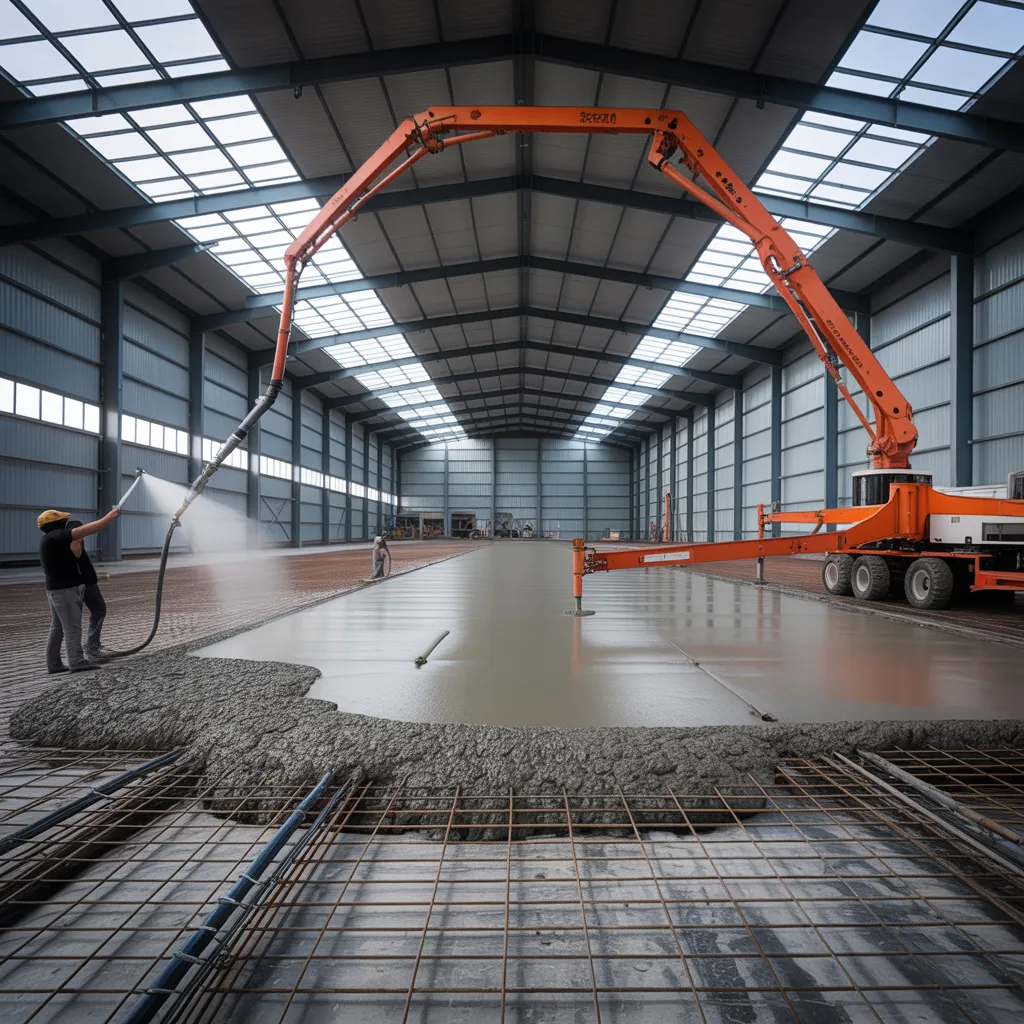
After approval, we complete permits and layout, then complete sawcut, demolition, and debris removal as required. We position forms to grade, install base material, vapor barriers, and reinforcement, and coordinate inspections. Our communication protocols keep you updated on mobilization and weather windows. We place concrete to specified slump, perform consolidation, screeding, floating, and edging, and apply control joints. Finish selections are performed, then curing procedures and protection measures follow. We complete punch list items, cleanup, and turnover documentation.
The Way to Assess Quotes, Timelines, and Warranties
Prior to any price comparison, examine each bid for scope precision, code compliance, and measurable deliverables. Verify concrete strength, mix design, base prep, reinforcement, joint layout, and curing technique. Demand line-item pricing to make a clean cost comparison and highlight allowances or exclusions. Establish permit responsibilities and inspection stages.
Leverage contractor interviews to confirm crew capacity, recent similar projects, and supervision on-site. Request a realistic schedule with timeline contingencies for weather, inspections, and material lead times; tie milestones to payment triggers. Review liquidated damages or incentives for schedule adherence.
Review warranties in writing: workmanship timeframe, materials coverage, crack thresholds, and maintenance stipulations. Validate warranty transfers to future owners and what voids coverage. Confirm certificates of insurance, licensing, and lien releases accompany the contract.
Expert Craftsmanship Features Which Elevate Aesthetic Appeal and Durability
You boost curb appeal and service life by demanding precision formwork and grading, proper reinforcement, and a mix design designed for load, freeze-thaw, and exposure. You designate consistent finishing techniques, then seal with the proper VOC-compliant product and coverage rate to resist moisture, deicing salts, and UV. You also set a maintenance plan-cleaning, joint care, and timely resealing-to keep surfaces more info looking sharp and performing well.
Accurate Formwork and Grading
Whereas concrete strength takes the spotlight, precision formwork and grading discreetly determine how straight, solid, and attractive your finished surface will be. You initiate by establishing tight control lines and setting forms plumb, square, and laser straight, using certified materials and firm bracing to withstand pour pressures. You validate elevations with slope mapping to channel water away from structures, adhering to local drainage codes and ADA thresholds where applicable. Subgrade preparation is crucial: you compact to specified density, proof-roll soft areas, and fine-grade to maintain uniform slab thickness. You install expansion joints, edge clearances, and curb reveals to the plans, then recheck form radii and offsets for consistent sightlines. Before placement, you confirm benchmarks, check falls, and document tolerances for inspection.
Mix Design and Reinforcement
The geometry is established by forms and grades; performance and appearance are locked in through reinforcement and mix design. You determine bar size, spacing, and cover to satisfy ACI and local code, fastening rebar or welded wire fabric so steel works in tension and transfers loads to base layer. At joints, you use dowels or continue steel to regulate movement and avoid differential settlement.
Choose a mix that balances aggregate strength, workability, shrinkage, and exposure class. Use appropriately graded aggregates, a w/c ratio aligned to durability, and air entrainment for freeze-thaw durability. Complementary cementitious materials enhance sulfate resistance and reduce permeability. Fine-tune admixtures to placement time and temperature, factoring in curing kinetics so early strength builds without excessive heat. Check batch tickets, slump, and entrained air. Place and consolidate uniformly to remove voids.
Maintenance, Sealing, and Finishing
The process of bringing your slab to life begins with disciplined finishing, then smart sealing, followed by a maintenance plan that protects both appearance and performance. You use a bull float to settle the paste, perform edging and jointing to control cracks, and apply a broom or trowel texture matched to slip resistance and drainage. Confirm the timing; never seal the surface prematurely. Cure according to ACI specifications—even moisture retention, correct temperature, and wind protection.
After 28 days or manufacturer-recommended cure, clean the surface, test for porosity, and apply a compatible sealer. Use penetrating sealers for driveways, film-formers for decorative work, and assure moisture mitigation to prevent whitening or delamination. Re-seal on schedule.
Schedule upkeep: consistent cleansing, immediate stain elimination, joint sealant inspections, and surface repair when flaking or spalling appears. Record service intervals.
Safety, Permits, and Code Compliance You Can Trust
From initial site assessment through final inspection, we make our priority safety, permitting, and code compliance to protect your project and timeline. You get meticulous pre-task planning, job hazard analyses, and daily toolbox talks that meet OSHA and Thornton's municipal standards. Our safety partnerships with suppliers and inspectors guarantee materials, mix designs, and equipment conform to specification before placement.
We handle permit navigation end-to-end: applications, plan check responses, utility locates, traffic control plans, and inspection scheduling. You'll receive accurate submittals, stamped drawings, and documented rebar, formwork, and embed inspections. We verify setbacks, frost depth, load paths, ADA slopes, and drainage to eliminate costly rework. During pours, we maintain shoring, PPE, controlled access, and test cylinders. You receive completion packages, as-builts, and compliance certificates.
Common Questions
Are You Offering Payment Plans or Financing for Large Concrete Projects?
Yes, you can choose payment plans or financing arrangements for large concrete projects. We'll go over payment options upfront, synchronize milestones with your budget planning, and provide a clear schedule linked to inspections and code compliance. You'll see itemized estimates, retainage terms, and authorized change-order procedures. We partner with third-party lenders or accept staged progress payments. You approve everything in writing, so cash flow remains predictable while we maintain safety, specifications, and schedule.
How Do You Handle Winter Scheduling and Weather Delays Handled?
We proactively adjust timelines, track weather predictions, and pause when temps risk cold pours. Worried about delays? You won't sacrifice quality or compliance-we follow ASTM/ACI freeze protocols, use heated enclosures, insulated blankets, and hot-water mixes to maintain cure temperatures. We time pours for midday, focus on critical-path tasks, and incorporate weather contingencies into your schedule and contract. You receive daily updates, updated milestones, and documented test results to ensure durability, safety, and timely completion when conditions permit.
Can I See Up-to-Date Local Referrals and Completed Project Sites?
Yes-you can examine latest local references and completed project addresses. I can provide a curated list, including client testimonials and a project portfolios summary with scope, mix designs, finish types, and permit numbers where applicable. For privacy, I'll provide exact addresses after obtaining homeowner consent. You can also schedule drive-bys of public-facing work and request contact information for past clients. I'll confirm code compliance, inspection records, and warranties for each referenced project.
What Is Your Policy for Post-Installation Maintenance Support?
Similar to a clearly marked path, we assist you after installation with a comprehensive maintenance plan. You'll receive periodic inspections at set intervals, a punch-list review after curing, and a care guide compliant with local codes. We respond to service requests within 48 hours, document all findings, and schedule corrective work as needed. You can opt for warranty extensions based on adherence to recommended cleaning, sealing, and load limits. We'll assess performance and provide annual condition reports.
Will You Offer Electronic Progress Updates and Pictures During the Project?
Yes-you'll receive digital progress updates and photos throughout the build. You'll log into a secure client portal with daily logs, plan markups, inspection notes, and weekly photos documenting key stages, rebar placement, mix tickets, and cure stages. We time-stamp and geotag images for verification and code compliance. You'll get alerts before key inspections and pours, plus change-order approvals in-app. This transparent workflow ensures you stay updated, reduces downtime, and guarantees a accurate, compliant final result.
Final Thoughts
By choosing trusted Thornton concrete contractor experts, you're not gambling-you're laying a foundation that lasts. You get local know‑how, code‑compliant designs, durable mix selections, and a clear process from estimate to final finish. Review bids, timelines, and warranties with confidence, and expect craftsmanship that enhances aesthetic appeal and functionality. With permits handled, safety prioritized, and details perfected, your project won't simply meet standards-it'll establish them. In Colorado's climate, your concrete becomes rock-solid reliability, not a gamble.